10 Best Packaging for Food Products for Global Buyers?
Choosing packaging for food products is a practical decision with consequences at every stage, from filling lines to long-distance delivery. A pouch that keeps roasted nuts crisp may not suit a sauce that needs a strong seal. A glass jar can show color beautifully, yet add weight and breakage risk during shipping. Details matter.
Food-packaging expert Dr. Aaron L. Brody’s guiding principle is: “Packaging must protect food quality while working for the product and its supply chain.” This captures the balance global buyers face. The right format should help limit moisture, oxygen, light, or physical damage, depending on the food. It should also fit storage conditions, transport routes, retail display, and consumer use. There is no universal winner.
This guide to the 10 Best Packaging for Food Products compares flexible pouches, cans, glass jars, cartons, trays, and other common options. It considers barrier performance, durability, convenience, presentation, and practical sourcing questions. A crisp snack needs different protection from a ready-to-eat meal. A shelf-stable product also has different needs from a chilled one. Small trade-offs can become costly at scale. And some choices are less obvious than they look.
Packaging For Food Products is not just a materials question. Buyers should ask how a pack behaves after sealing, stacking, and shipping—not only how it looks on a sample table. This overview offers a grounded starting point, though supplier data and product testing still matter. A shortlist is useful. It is not proof.
Understanding the Purpose of Food Packaging in Global Trade
For global buyers, food packaging is more than a container. It protects product quality across long, changing routes. A carton may sit on a warm loading dock, then travel through a chilled warehouse. Packaging must help manage moisture, oxygen, light, and impact, depending on the food. Small details matter. A secure seal can prevent leaks, while a clear date code helps workers rotate stock.
Packaging also carries information between producers, carriers, retailers, and consumers. Readable ingredient, allergen, storage, and lot details support safer handling and faster checks when questions arise. Buyers should confirm that labels remain legible after condensation or abrasion. A label that looks clear in a sample room may blur after weeks in transit. That possibility deserves a real shipping test, not just a visual review.
The right format depends on the product and route. Flexible pouches can reduce shipping weight, while rigid containers may better protect fragile items. Neither option is automatically best. Teams need to weigh barrier performance, stacking strength, opening ease, and disposal choices against actual transport conditions. More layers may protect food, but they can also add material and complicate sorting. I would question any specification that ignores what happens after delivery, especially in markets where collection systems differ. A practical trial with filled packs, temperature changes, and rough handling can reveal weak points before a large order ships.
Food Packaging for Global Trade: EU Packaging Recycling Rates
Recycling rates offer one useful reference when comparing packaging materials. For global buyers, the right choice also depends on food protection, shelf life, transport conditions, and recycling infrastructure in the destination market.
EU-27 packaging waste recycling rates, 2022: paper and cardboard 82.1%, glass 75. glass? Let's not.
Criteria for Matching Packaging to Food Products
Packaging should match the food’s moisture, fat, acidity, temperature, and expected shelf life. Dry grains need a strong moisture barrier; oily snacks also need protection from oxygen and light. For chilled meals, check that seals stay intact after condensation and repeated handling. Frozen products need flexible materials that resist cracking at low temperatures. Fit matters.
Transport conditions matter as much as the product itself. A glass jar may suit a sauce, yet add weight and breakage risk during long-distance shipping. Flexible pouches can reduce shipping weight, but weak seals may allow leaks or oxygen exposure. Test samples through the actual filling, storage, and distribution conditions—not just on a clean desk. That step is easy to skip.
Food protection has measurable stakes: FAO estimated that 13.2% of food was lost between harvest and retail in 2021. Packaging cannot prevent every loss, but a suitable barrier and secure closure can help protect quality. Material choices also carry trade-offs. OECD’s Global Plastics Outlook reports that packaging generated about 40% of global plastic waste in 2019. Buyers should compare protection, shelf life, transport impact, and local recovery options. The “best” pack may change by route. That deserves a second look.
10 Best Packaging for Food Products for Global Buyers? - Criteria for Matching Packaging to Food Products
| Packaging Format | Best-Fit Food Products | Protection to Consider | Main Advantages | Trade-Offs | Global Buyer Matching Criteria |
|---|---|---|---|---|---|
| Glass jars and bottles | Jams, sauces, pickles, beverages, honey, and preserved foods | Glass provides a strong barrier to moisture, gases, and odors. Closures and seals must be suitable for the product and filling process. | Transparent, chemically inert for many foods, reusable, and widely recyclable where collection systems exist. | Heavy and breakable; shipping weight and protective secondary packaging can increase transport costs. | Check breakage risk, closure compatibility, filling temperature, freight cost, and local glass-recycling infrastructure. |
| Metal cans | Vegetables, beans, soups, seafood, meat, and shelf-stable drinks | Rigid metal construction protects against light and physical damage. Food-contact lining and seam integrity are important. | Suitable for long-life products when correctly processed and sealed; stackable and resistant to crushing. | Opaque, and cans may dent or corrode if damaged or stored in unsuitable conditions. Lining selection matters for certain foods. | Match can dimensions and lining to acidity, salt, processing conditions, expected shelf life, and destination-market food-contact rules. |
| Flexible barrier pouches | Snacks, dried fruit, coffee, powdered foods, sauces, and retort meals | Barrier performance depends on the laminate structure; specify oxygen, moisture, light, and seal requirements for the food. | Lightweight, space-efficient, and available in resealable or portion formats. | Multilayer structures can be difficult to recycle in many markets; puncture resistance and seal quality require validation. | Confirm product sensitivity, shipping conditions, pouch construction, sealing equipment, and local collection or recycling options. |
| Plastic bottles and jars | Cooking oils, sauces, dressings, dairy drinks, and dry ingredients | Barrier and light protection vary by resin, color, wall thickness, and closure. Select materials for the specific food and filling conditions. | Lightweight, shatter-resistant, and compatible with a wide range of shapes and dispensing closures. | Some formats offer limited oxygen or light protection; recycling availability varies by polymer and location. | Check food-contact compliance, product compatibility, closure seal, transport durability, and the destination country's recycling system. |
| Paperboard cartons and boxes | Cereals, crackers, confectionery, frozen foods, and secondary food packaging | Paperboard alone is not a strong moisture or gas barrier. Liners, coatings, or an inner bag may be needed. | Lightweight, printable, and easy to stack; commonly used for shelf display and outer protection. | Can lose strength when wet; barrier coatings and attached components may affect recyclability. | Assess humidity exposure, required inner packaging, stacking strength, print and labeling needs, and local paper-recycling guidance. |
| Corrugated shipping cases | Bulk produce, packaged foods, bottles, cans, and multi-unit shipments | Provides transport cushioning and stacking support; strength depends on board construction, design, and moisture exposure. | Efficient for palletizing and distribution; can be made in various sizes and is widely used in shipping. | Performance can decrease in wet or humid conditions; oversized cases waste space and material. | Match case strength and dimensions to pallet pattern, shipment weight, stacking time, route conditions, and warehouse handling. |
| Vacuum-sealed bags | Cheese, processed meats, coffee, and selected chilled or frozen foods | Air removal can reduce oxygen exposure, but the film must provide suitable barrier and seal performance for the food. | Compact packs can help limit air in the package and support efficient storage. | Not suitable for every food; package integrity, product shape, and refrigeration requirements remain important. | Verify food-specific shelf-life testing, film compatibility, seal strength, cold-chain needs, and destination labeling requirements. |
| Modified-atmosphere trays | Fresh meat, poultry, seafood, salads, and prepared chilled foods | Gas mixture, tray, film, seal, and temperature control work together; performance depends on the product and distribution conditions. | Can support product presentation and chilled distribution when the system is properly designed and validated. | Requires suitable gas-flushing and sealing equipment, reliable cold-chain handling, and product-specific validation. | Check gas composition, film permeability, tray recyclability, equipment availability, cold-chain reliability, and local food regulations. |
| Aseptic cartons | Milk alternatives, dairy products, juices, soups, and other suitable beverages or liquid foods | Barrier layers and aseptic processing protect the product when packaging and filling conditions are correctly controlled. | Lightweight and stackable; suitable formats can support ambient distribution before opening. | Requires specialized filling systems; composite materials may have limited recycling access in some markets. | Confirm product-process compatibility, filling infrastructure, storage conditions, package size, and local collection facilities. |
| Molded-fiber trays and cartons | Eggs, produce, and selected dry or protected foods | Provides cushioning and shape support. Moisture resistance and direct food-contact suitability depend on material and any treatment used. | Protective, lightweight, and often made with recovered fiber; useful for products needing cushioning. | Can absorb moisture and may not provide a high gas or water-vapor barrier without additional components. | Evaluate food-contact status, moisture exposure, cushioning needs, stacking performance, and regional recycling or composting acceptance. |
Selection note: Packaging suitability depends on the food, processing method, intended shelf life, transport route, storage conditions, and destination-market requirements. Validate food-contact compliance and package performance for each specific application.
Ten Leading Food Packaging Formats for Global Buyers
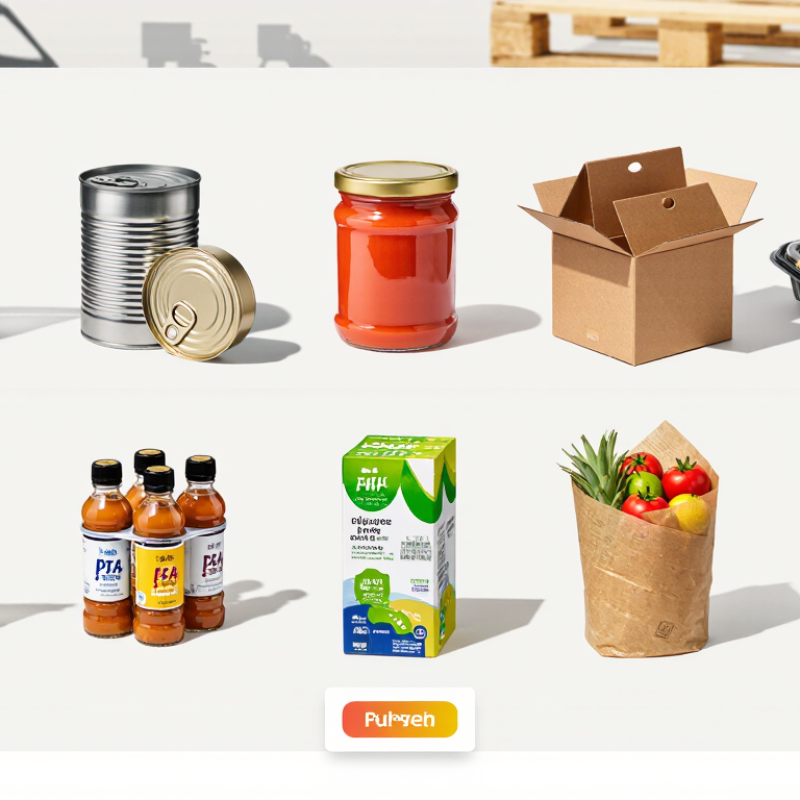
Global buyers can compare ten leading food packaging formats by protection, shipping weight, shelf life, and local disposal options. Flexible pouches suit sauces and snacks; films wrap fresh produce; paperboard cartons hold dry goods and beverages. Corrugated cases protect shipments, while rigid tubs and PET trays display chilled foods. Glass jars offer strong product visibility, and metal cans support long storage. Vacuum packs and retort pouches help protect selected foods through distribution. Each format has limits: glass is heavy, and flexible laminates can be difficult to recycle.
Packaging choices matter beyond presentation. FAO’s 2023 SDG Progress Report estimated that 13.2% of food was lost after harvest and before retail in 2021. Suitable packaging can help protect products during handling, though it cannot prevent every loss. The OECD’s 2022 Global Plastics Outlook reports that packaging generated about 40% of plastic waste in 2019. Buyers should therefore assess protection alongside material use and end-of-life options. Small details matter.
Tips: Test samples under realistic shipping conditions: temperature changes, stacking, vibration, and moisture. Confirm pack dimensions and barrier performance with suppliers, then check whether materials are accepted in the destination market’s waste system. These checks take time, and sometimes the simplest-looking pack performs poorly in transit.
Comparing Shelf Life, Shipping Durability, and Sustainability
For global buyers, packaging must protect food without adding unnecessary shipping weight. FAO estimated that 14% of food was lost between harvest and retail in 2016, highlighting the value of effective protection (The State of Food and Agriculture, 2019). A high-barrier pouch can slow oxygen and moisture exposure in dry foods. Fresh produce often needs ventilation instead. There is no universal winner.
Shipping changes the calculation. Glass offers a strong moisture and gas barrier, but its weight increases freight demands and breakage risk. Corrugated boxes cushion jars and cans, yet can soften when exposed to damp warehouse floors. Test samples under vibration, compression, and temperature changes. Real routes reveal weaknesses.
Sustainability also requires trade-offs. OECD reported that packaging generated about 40% of global plastic waste in 2019 (Global Plastics Outlook, 2022). That figure supports reducing excess material, not removing protection blindly. A thinner pack may cut material use but raise spoilage risk. Compare total package weight, recycled content, and food loss across the full supply chain. One detail gets overlooked: local recycling access can matter more than a package’s theoretical recyclability.
Checking Food-Contact Rules and Supplier Requirements
Food-contact compliance begins with the intended use, not a supplier’s generic “food grade” claim. Specify the food type, contact time, temperature, and whether packaging touches hot, oily, acidic, or frozen products. Rules differ by destination, material, and use. Check current requirements in each target market, and confirm whether declarations, migration testing, or other records are expected.
Ask suppliers for material specifications, food-contact declarations, relevant test reports, and traceability details for every component, including inks, adhesives, coatings, and closures. Reports should match the exact material, thickness, and use conditions; a test for a similar film may not support your product. Request lot identification and written notice before formulation or production-site changes. Keep samples from approved production lots where practical.
Look closely. During qualification, compare documents with the physical pack: smell, seal strength, print rub-off, and performance after filling. These checks do not replace laboratory testing, but they can expose gaps early. Verify that the laboratory and testing methods suit the destination market. Paperwork can look complete and still be outdated, so record document dates and review them when specifications change. A tidy checklist helps, but it cannot replace a clear conversation with the supplier.
Related Posts
-
Ultimate Guide to Choosing the Best Food Packaging Solutions for Your Business
-
How to Choose Effective Food Packaging Solutions for Your Products
-
Best Food Packaging Solutions for Your Business Needs?
-

What Is the Best Food Packaging Supplier in China?
-
Innovative Food Packaging Solutions 5 Compelling Reasons to Upgrade Your Supply Chain
-
Maximizing Your Investment with Best Food Packaging Solutions 5 Essential After Sales Service Tips