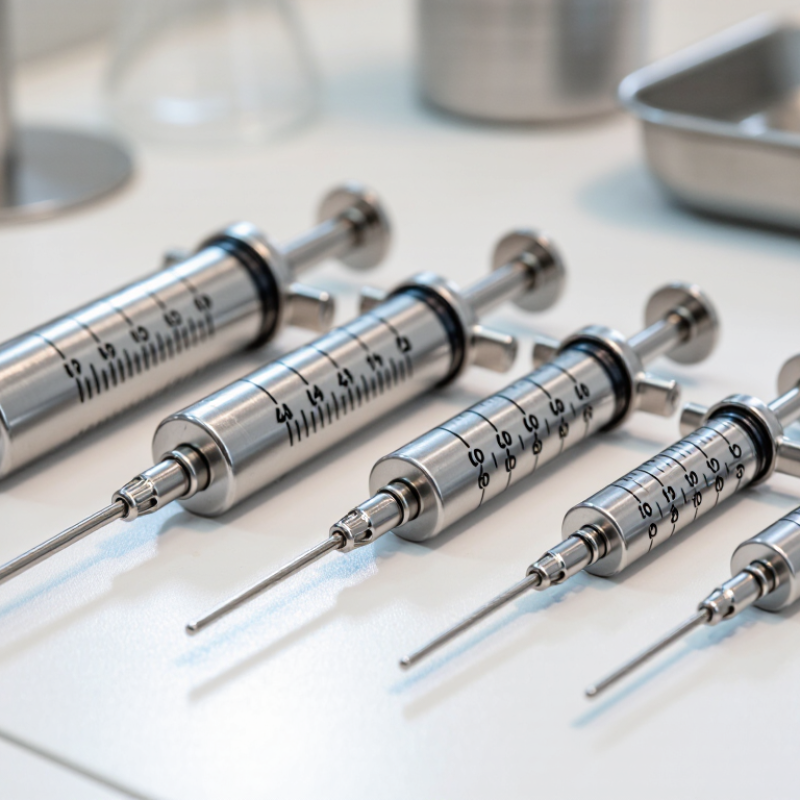
How to Choose Stainless Steel Syringes for Global Sourcing

Choosing Stainless Steel Syringes for global sourcing requires more than comparing unit prices. Material grade, dimensional accuracy, surface finish, and supplier traceability directly affect safety and performance. A syringe may look polished under warehouse lighting, yet microscopic burrs can damage seals or disrupt fluid delivery.

Industry evidence supports careful qualification. The World Health Organization’s Global Vaccine Market Report highlights the importance of reliable medical-device supply chains, quality assurance, and regional manufacturing capacity. Grand View Research’s 2024 prefilled syringes market analysis also points to rising demand for accurate, durable, and contamination-controlled delivery systems. These findings are relevant, although they do not answer every stainless-steel sourcing question.

Experienced buyers should verify the steel specification, commonly 304 or 316L, against the intended chemical and sterilization environment. Ask for mill certificates, inspection records, ISO 13485 certification, and lot-level traceability. Confirm Luer compatibility, plunger travel, dead-space volume, and leak-test results. Small details matter. A poorly finished tip can become an expensive quality complaint.

Supplier audits should examine passivation controls, cleanroom practices, packaging integrity, and corrective-action history. Request representative samples before approving a production order. Test them under realistic conditions, including repeated connections and temperature changes. Do not rely on attractive photographs.

A lower quotation can hide weaker documentation or inconsistent tolerances. That assumption can also be wrong. Total cost should include testing, import requirements, rejected batches, and delivery risk. Applicable ISO standards, national medical-device rules, and destination-market requirements must guide the final decision. This guide offers a practical framework, but technical review remains essential for every application.

How to Choose Stainless Steel Syringes for Global Sourcing

Define the Application and Performance Requirements

Choosing stainless steel syringes for global sourcing starts with a clear application definition.

Describe the fluid, volume, viscosity, temperature, and operating pressure. A thin solvent may require different seals than a thick oil. Corrosive fluids need verified material compatibility, not assumptions. Small details matter.

Performance requirements should match the actual process.
Specify barrel capacity, tip connection, needle gauge, stroke force, dosing accuracy, and acceptable dead space. For repeated use, assess cleaning methods, sterilization exposure, and cycle life. For sensitive dosing, request test data and tolerance limits. In my experience, suppliers often quote standard dimensions first, while the real issue is seal behavior under pressure. That gap deserves attention.

Tips: Prepare a one-page requirement sheet before contacting suppliers. Include fluid samples or technical data when possible. Ask for material certificates, dimensional drawings, inspection records, and performance reports. Confirm whether measurements use the same test conditions as your facility. Do not judge a syringe by stainless steel grade alone. I have seen a technically strong design perform poorly because its connector was overlooked. A small pilot evaluation can reveal that problem early. Keep findings documented, including failures and revisions.

Compare Stainless Steel Syringe Materials and Construction

When choosing stainless steel syringes, compare alloy, surface finish, and construction together. Grade 304 is economical and suitable for many low-corrosion environments. Grade 316L adds molybdenum, improving resistance to chlorides and repeated cleaning. Its low carbon content also reduces weld-related corrosion risks. Better, but not automatically better.

World Stainless reported 58.4 million tonnes of crude stainless steel production in 2023. USGS reported global nickel mine production near 3.6 million metric tons that year. These figures show supply scale, not guaranteed medical-grade availability. Nickel prices can still affect 316L quotations and lead times. Ask suppliers for heat numbers, chemical analysis, and traceable certificates. Do not rely on a shiny finish alone.

Construction details often decide service life. A seamless barrel can reduce crevices, while poorly finished welds may trap residue. Electropolishing can improve cleanability, but it cannot remove deep scratches or design flaws. Check plunger alignment, seal compatibility, dead space, and dimensional repeatability. ISO 7886-1 may provide a useful performance reference where applicable. For needle assemblies, review ISO 9626 requirements separately. In practical audits, I would inspect several production samples, not one perfect sample. That choice costs time. It can prevent expensive surprises. Salt-spray results also need caution; they may not represent real cleaning cycles. Ask for validation data using your actual chemicals, temperature, and contact time.

How to Choose Stainless Steel Syringes for Global Sourcing

Compare Stainless Steel Syringe Materials and Construction

How to read the chart: 304 stainless steel is a common general-purpose option, while 316L offers improved resistance to chloride-containing environments because it contains molybdenum. 17-4 PH provides higher strength and hardness after heat treatment, but it is not normally selected when maximum corrosion resistance is the primary requirement.

Construction considerations: For reusable syringes, evaluate seamless or welded barrel construction, plunger fit, surface finish, cleaning access, dimensional tolerance, and compatibility with sterilization methods. The final choice should be confirmed against the fluid, sterilization cycle, required service life, and applicable regulatory requirements.

Composition values show commonly specified ranges or representative midpoints by mass based on widely used stainless steel grade specifications. Actual values may vary by applicable standard and product specification.

Evaluate Sterility, Compatibility, and Safety Standards

When sourcing stainless steel syringes globally, verify sterility claims before comparing prices. Ask whether each unit is sterile, sterilizable, or supplied for controlled cleaning. These descriptions are not interchangeable. Request the sterilization method, validation summary, expiry period, and packaging integrity data. Check lot numbers and traceability records. A sealed pouch can still fail after rough transport. Inspect seals, labels, and physical damage during incoming inspection.

Compatibility requires more than checking the fluid name. Review the stainless steel grade, internal finish, gasket material, lubricant, and connector design. Test exposure to solvents, biological fluids, cleaning agents, and repeated heat cycles. Watch for corrosion, swelling, particles, or changes in plunger movement. Small details matter. I have seen a smooth syringe perform poorly because its seal material reacted with the formulation. That mistake was preventable, but supplier documents did not reveal it clearly.

Safety evaluation should include dimensional checks, leak testing, pressure resistance, and needle or connector fit. Request certificates of analysis, inspection reports, and evidence of quality-system control. Compare documentation with applicable ISO, ASTM, and local regulatory requirements. Do not accept a generic compliance statement without supporting records. Samples should undergo independent testing when the application is sensitive. One weakness remains easy to overlook: a supplier may pass laboratory checks but fail consistency across production lots. This is where regular audits and defined acceptance criteria become essential.

How to Choose Stainless Steel Syringes for Global Sourcing - Evaluate Sterility, Compatibility, and Safety Standards

Evaluation Dimension What to Check Evidence or Specification to Request Practical Acceptance Guidance Priority
Intended Use Define whether the syringe is for medical injection, laboratory sampling, chromatography, gas handling, dosing, or industrial fluid transfer. Application description, fluid type, operating temperature, pressure, volume range, and required accuracy. Do not treat a laboratory or industrial stainless steel syringe as suitable for patient use unless it is specifically designed, validated, labeled, and regulated for that purpose. Critical
Sterility Status Confirm whether the product is supplied sterile, non-sterile for laboratory use, or intended for validated reprocessing. Product labeling, sterility claim, sterilization method, sterility release records, and packaging integrity documentation. For sterile medical products, the sterilization process should be validated and supported by a defined sterility assurance level, commonly a target of 10-6 for terminally sterilized products where applicable. Critical
Sterilization Method Assess compatibility of the stainless steel, seals, lubricant, markings, and packaging with the proposed sterilization cycle. Validation reference for moist heat, ethylene oxide, radiation, or another applicable process; cycle parameters and material-impact data. Relevant international frameworks include ISO 17665 for moist heat, ISO 11135 for ethylene oxide, and ISO 11137 for radiation sterilization. Applicability depends on the product and process. Critical
Packaging and Shelf Life Check protection against puncture, corrosion, contamination, moisture, and loss of sterility during transport and storage. Packaging validation, seal-strength and integrity results, defined storage conditions, expiry date, and transport simulation records. For sterile barrier systems, ISO 11607-1 and ISO 11607-2 are commonly used to address packaging materials, forming, sealing, assembly, and process validation. Critical
Stainless Steel Grade Verify the alloy used for the barrel, needle, plunger, fittings, and any wetted components. Material certificate, grade designation, chemical composition, heat-treatment information, and traceability record. 316L is often selected where improved resistance to chloride-containing or corrosive environments is needed; 304 may be suitable for less aggressive applications. Neither grade is universally compatible with every chemical. High
Chemical Compatibility Evaluate the fluid’s pH, chloride level, oxidizing strength, solvent content, concentration, temperature, and contact time. Compatibility matrix, immersion or exposure test results, corrosion inspection, extractables assessment, and seal-material compatibility data. Pay particular attention to chlorides, strong acids, strong alkalis, halides, oxidizers, and stagnant conditions. Test the complete fluid path rather than the steel alone. Critical
Seals and Non-Metallic Parts Inspect elastomers, plastics, adhesives, lubricants, gaskets, and any coating that contacts the fluid. Material identity, temperature range, chemical compatibility results, extractables and leachables information, and change-control records. A corrosion-resistant metal body does not ensure compatibility if seals or lubricants swell, harden, shed particles, or contaminate the fluid. Critical
Dose Accuracy and Repeatability Compare nominal volume, graduation readability, dead volume, delivery accuracy, and repeatability under defined conditions. Dimensional drawings, calibration method, test temperature, sample size, measurement uncertainty, and acceptance limits. Use a test method appropriate to the syringe type and volume. Accuracy claims should identify whether they refer to delivered volume, indicated volume, or gravimetric measurement. High
Leak Tightness and Pressure Check barrel-to-plunger sealing, fitting integrity, needle connection, and resistance to the intended pressure or vacuum. Leak test method, pressure or vacuum level, dwell time, connection standard, and recorded acceptance criteria. Gas-tight performance requires special design and testing. A syringe suitable for liquid transfer may not be suitable for gas sampling or pressurized applications. Critical
Biocompatibility For patient-contacting or specimen-contacting products, evaluate all materials that may contact the body or sample. Biological evaluation plan and applicable test reports covering cytotoxicity, sensitization, irritation, systemic toxicity, or other endpoints as justified by contact type and duration. ISO 10993-1 provides a risk-based framework for biological evaluation of medical devices. The required endpoints depend on contact nature and exposure duration. Critical
Medical Device Quality System Determine whether the manufacturing site operates a controlled quality system appropriate to the product’s intended market. Current quality-system certificate, audit summary, supplier qualification records, complaint handling, CAPA, and change-control procedures. ISO 13485 is the principal international quality-management standard for medical devices. Certification alone does not prove that a particular syringe is sterile or fit for the intended use. High
Risk Management Review hazards related to breakage, leakage, incorrect dose, contamination, corrosion, sharp edges, and foreseeable misuse. Risk-management file, hazard analysis, usability assessment where relevant, verification records, and residual-risk evaluation. ISO 14971 provides a recognized framework for applying risk management to medical devices throughout the product life cycle. High
Product and Lot Traceability Confirm that raw materials, production lots, sterilization batches, inspection records, and distribution units can be traced. Lot or batch number, unique product code, certificate of conformity, material certificates, and retention-period policy. Traceability should support investigation of nonconformities, targeted recalls, and verification of sterilization or inspection history. High
Labeling and Instructions Check intended use, warnings, sterility status, single-use or reusable designation, storage conditions, expiry, and reprocessing instructions. Label artwork, instructions for use, symbols, language versions, and market-specific regulatory documentation. ISO 15223-1 addresses commonly used medical-device symbols, while ISO 20417 addresses information supplied by the manufacturer. Verify local legal requirements before import. High
Reusable Product Reprocessing For reusable syringes, assess cleaning, disinfection, sterilization, drying, inspection, and maximum validated reuse cycles. Validated reprocessing instructions, worst-case cleaning studies, residual contamination results, inspection criteria, and cycle-life testing. Reuse should not be assumed from the presence of stainless steel. Reprocessing must be validated for the complete device, including seals, markings, fittings, and internal channels. Critical
Global Regulatory Fit Identify the classification, registration, import, labeling, and documentation requirements in each destination market. Regulatory classification, conformity assessment route, declaration of conformity where applicable, import documents, and authorized representative arrangements when required. Requirements vary by jurisdiction and intended use. Obtain a country-specific regulatory review before commercial shipment rather than relying only on a general quality certificate. Critical
Supplier Change Control Determine how changes to alloy, seals, tooling, sterilization site, packaging, process parameters, or subcontractors are controlled. Written change-notification procedure, approval thresholds, revalidation policy, and advance-notice commitment. Require notification before changes that could affect sterility, dimensions, chemical compatibility, biocompatibility, accuracy, or regulatory status. High
Procurement note: Standards and regulatory expectations depend on the syringe’s intended use, market, and risk classification. Request current, product-specific evidence and verify that test reports cover the exact configuration, materials, sterilization process, and packaging being sourced.

Assess Suppliers, Manufacturing Quality, and Traceability

How to Choose Stainless Steel Syringes for Global Sourcing

Global sourcing requires more than comparing unit prices. The World Health Organization estimates that about 16 billion injections are administered worldwide each year, making consistent quality essential. For stainless steel syringes, evaluate the supplier’s material controls, machining process, and inspection records. Request the steel grade, heat number, mill certificate, and passivation evidence. Check whether critical dimensions, plunger fit, dead space, and leak resistance are measured by calibrated equipment. Small deviations can affect dosing accuracy.

Ask for documented traceability from incoming steel to finished cartons. A reliable supplier should connect each production lot with operator records, inspection results, nonconformance reports, and shipment details.

ISO 13485:2016 emphasizes risk-based quality systems and controlled production, but certification alone proves little about daily execution. Look inside the process.

Can the factory retrieve one lot’s records within hours? Is every gauge calibration current? Are cleaning and sterilization steps validated for the intended use?

Independent sampling is wise. A 2023 WHO and UNICEF injection-safety assessment again linked unsafe injection practices with preventable infection risks, highlighting why surface cleanliness and reprocessing controls deserve scrutiny. Ask for surface-finish data, corrosion testing, and packaging-integrity results.

Documents may look excellent. Factory habits can still be inconsistent. That is where careful supplier visits, third-party testing, and a written corrective-action process become necessary.

Supplier selection is never perfectly certain; it is an ongoing evidence review.

Verify Pricing, Logistics, and Global Sourcing Terms

Choosing stainless steel syringes for global sourcing requires more than comparing unit prices.

The International Stainless Steel Forum reported approximately 58.4 million tonnes of global stainless steel production in 2023. That scale does not guarantee consistent quality. Ask suppliers for the exact steel grade, hardness, surface finish, dimensional tolerances, and material certificates. Request sample measurements, not only catalog photographs. A polished barrel may still contain burrs or uneven plunger resistance.

Pricing needs a landed-cost worksheet. Separate steel surcharges, machining, packaging, inspection, tooling, and replacement parts. Confirm whether the quotation is EXW, FOB, CIF, or DAP. These terms shift freight, insurance, customs handling, and delivery risk. UNCTAD’s Review of Maritime Transport notes that over 80% of global merchandise trade by volume moves by sea. Freight delays can therefore affect production schedules, even with a reliable factory. State the currency, quotation validity, minimum order quantity, payment milestones, and lead time in writing. A perfect quote can still be misleading.

Logistics details deserve physical verification. Check carton dimensions, moisture protection, pallet limits, and the number of syringes per carton. Require pre-shipment inspection and retain a sealed reference sample. For international classification, confirm the applicable tariff code with a customs professional; material and intended use can change treatment. I usually add a small contingency for port charges and rework. It feels inefficient, but ignoring them is worse. The World Bank’s Commodity Markets Outlook also tracks nickel price movements, which can influence stainless steel cost discussions. Recheck any alloy surcharge before approving a long-term contract.