How to Choose the Best Recyclable Packaging Bags?
Choosing a Recyclable packaging bag is not as simple as picking a green-looking pouch. The material, product, and local recycling system all matter. A bag made from one recyclable material may be easier to process than a pouch combining several bonded layers. Yet a single-material design still needs to protect the product. Moisture, air, and light can affect shelf life.
Circular-design expert William McDonough is associated with the principle, “Waste equals food.” It is a useful lens for packaging choices: a bag should be considered beyond its time on the shelf. Can its material be collected, sorted, and turned into something useful? Check the bag’s material specifications, recycling instructions, and compatibility with the collection systems available to your customers. Do not rely on appearance alone. A matte finish, a leaf symbol, or a “recyclable” label cannot confirm that local facilities accept the package.
Details count. A zipper, printed ink, adhesive, or barrier coating can affect how a package is sorted or processed. Ask suppliers for technical data and evidence supporting recyclability claims. Then test the bag with the real product, not just an empty sample. A crisp pouch may look ideal on a desk, but fail when filled, shipped, or handled.
There are trade-offs. This guide cannot identify one perfect bag for every product or location. The practical choice balances protection, material simplicity, verified recycling access, and cost. Some answers remain inconvenient. That is worth acknowledging.
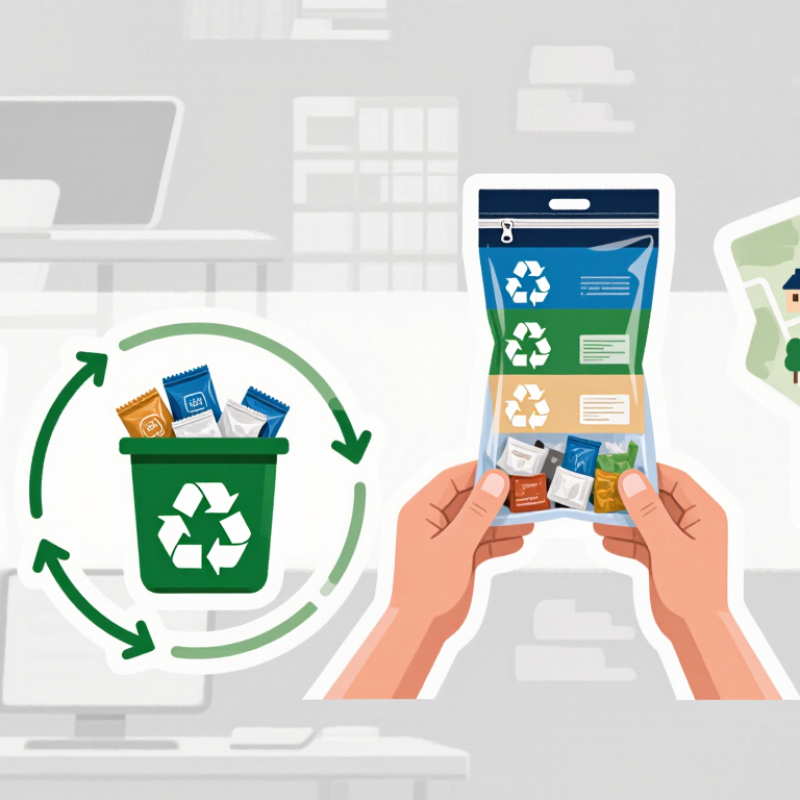
What Recyclable Packaging Bags Are and How They Work
A recyclable packaging bag is designed so its main material can be collected, sorted, and reprocessed into raw material. Many flexible bags use polyethylene, rather than layers of different plastics bonded together. In mechanical recycling, collected film is sorted, washed, shredded, and melted into pellets for new products. The process depends on the bag’s structure and local facilities. A recyclable design is not automatically recyclable everywhere.
That distinction matters. The OECD’s Global Plastics Outlook (2022) estimates that just 9% of plastic waste worldwide was ultimately recycled in 2019. Small details can affect a bag’s path: mixed-material layers, closures, inks, and residue may complicate sorting or processing. The Association of Plastic Recyclers’ Design Guide for Plastics Recyclability assesses how packaging components affect recycling compatibility. Check local collection instructions, too; some communities accept films at specific drop-off points, while curbside programs may not. I would not rely on a recycling symbol alone. The system is less tidy than the label suggests.
How to Identify Local Recycling Options and Requirements
Local recycling rules can change across town lines, even when two bags look identical. Start with your city or county waste authority’s website. Search for “plastic film,” “flexible packaging,” and the bag’s resin code. A code alone does not guarantee curbside acceptance. Call if the guidance is vague. Ask whether the bag belongs in a curbside bin, a store drop-off point, or household trash. Confirm whether it must be clean, dry, and empty. Keep it dry. Check collection hours, too; a drop-off point may accept bags only during staffed hours.
National figures explain why checking locally matters. The OECD’s Global Plastics Outlook (2022) estimated that only 9% of global plastic waste was recycled in 2019. The U.S. EPA’s 2018 materials report recorded an 8.7% recycling rate for plastics overall. These are broad figures, not proof that a particular bag is accepted nearby. Some drop-off sites exclude multilayer pouches or bags with food residue. Take a quick photo of the bag and ask the local program staff if its material is unclear. I still double-check. Local instructions can be incomplete, and that uncertainty deserves attention.
How to Match Bag Materials to Product and Shipping Needs
Match the bag to the product first: moisture, grease, puncture risk, and shelf life all affect material needs. Dry apparel can often travel in a mono-material polyethylene (PE) mailer, where local collection accepts it. For damp goods, paper may soften; PE can resist moisture, but it is not recyclable everywhere. Check local collection rules. Products needing strong aroma or oxygen barriers may use multilayer laminates. These bonded layers can be harder to recycle. Protection still matters: a leaking shipment can waste both product and packaging.
Shipping changes the calculation. A snug bag can reduce void space and weigh less than a rigid box, while sharp edges or heavy contents may need reinforcement. Test packed samples for drops, compression, and seal strength. A bag that looks recyclable but fails in transit is a poor match. OECD’s Global Plastics Outlook (2022) estimates packaging generated 40% of global plastic waste in 2019. UNEP’s Turning off the Tap (2023) reports that packaging accounts for about 36% of plastics produced. These figures make material choice consequential, but they do not prove one format is best. Ask suppliers for material composition, recycling-design evidence, and destination-specific collection data. Then check actual damage rates. This part can be messy.
How to Compare Durability, Protection, and Environmental Impact
When comparing recyclable packaging bags, test them with the product they will actually carry. A dry sample can look sturdy but split when filled with sharp-edged goods. Check the seams, handles, and closure after lifting a realistic load. Check the seams. A small tear near a seal can matter more than a thick-looking film.
Protection depends on what the contents need. For powders, inspect seal quality and rub a filled bag gently to spot leaks. For items sensitive to moisture, ask for barrier data and test bags under expected storage conditions. Not always. More layers may improve protection, but they can also complicate recycling if the materials are difficult to separate. Request clear material details rather than relying on a “recyclable” label alone.
Environmental impact includes what happens after use. Check whether local collection programs accept the bag’s material and format; acceptance varies by area. Compare the amount of packaging needed to prevent damage, since spoiled or broken goods also carry an environmental cost. A thinner bag may use less material, yet fail during delivery. That trade-off deserves a real trial, not guesswork. Keep test results, including failures, because one rough edge or damp storage room can change the choice.
How to Verify Recyclability Claims and Choose a Supplier
How to Choose the Best Recyclable Packaging Bags?
How to Verify Recyclability Claims and Choose a Supplier
A “recyclable” label does not guarantee that a bag will be recycled. The OECD’s Global Plastics Outlook (2022) estimated that only 9% of global plastic waste was recycled in 2019. That gap matters. Check whether local collection programs accept the bag and whether nearby facilities can sort and reprocess its exact material. A bag may use recyclable film but include closures, inks, or labels that complicate processing.
Ask suppliers for material specifications, independent test results, and written details about the bag’s full structure. Confirm that evidence applies to the exact product, not just its main resin. Ask how specifications are maintained across production batches. A polished sample is useful, but it cannot prove consistent quality. I would also ask for references from customers using similar bags; some details may be hard to verify without them.
Tips: Request documentation before ordering. Check local acceptance rules. Ask for proof. Compare suppliers on evidence, not promises.
