What Are the 7 Best Thermal Sticker Labels?
Choosing the right Thermal Sticker Labels starts with the job, not the product name. A label for a shipping carton faces different demands from one attached to a chilled jar or a retail shelf tag. Printer compatibility matters, too. Check the label width, core size, roll direction, and print method before comparing prices. A roll that almost fits is still the wrong roll.
Quality expert W. Edwards Deming is widely associated with the principle, “Quality is everyone’s responsibility.” That idea applies here: buyers, operators, and suppliers all influence whether a label stays readable and attached. Direct thermal labels can suit short-term tasks, while thermal transfer labels are often chosen when greater resistance to handling or fading is needed. But the right choice depends on the label stock, ribbon, surface, and storage conditions—not a simple ranking.
Small details count. Picture a barcode crossing a carton seam, or a freezer label lifting at one corner. Those are real selection tests. This guide compares seven popular options by print clarity, adhesion, durability, compatibility, and value. No single label wins every use case. And a price comparison alone can mislead. It is worth testing a sample on the actual surface before ordering a case; even a careful shortlist cannot predict every adhesive’s behavior in your workspace.
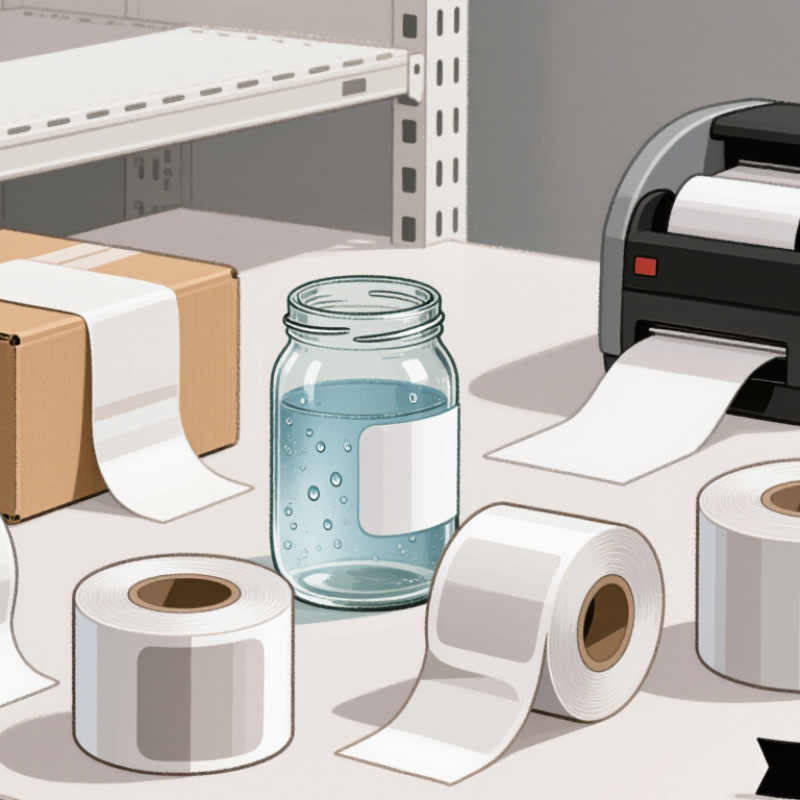
How Thermal Sticker Labels Work and Where They Are Used
Thermal sticker labels print when a printer applies heat to a coated surface. In direct thermal printing, the heated printhead darkens the label itself, so no ink cartridge is needed. It is a simple setup. The trade-off is that heat, sunlight, and friction can fade the print over time. A parcel label stored in a hot delivery van may become harder to scan.
Thermal-transfer printing works differently: heat moves ink from a ribbon onto the label. This method can produce marks that last longer, depending on the ribbon and label material. Paper labels suit many indoor tasks, while synthetic materials can handle more moisture and handling. The right choice depends on the label’s journey, not just its price.
You’ll see these labels on shipping parcels, retail price tags, warehouse bins, and food packages marked with dates. In a small shop, staff might print a price and barcode at a counter, then apply the label by hand. In a busy stockroom, clear contrast and consistent placement help scanners read codes quickly. Test labels under real conditions when possible. A label that looks crisp on a desk may not stay readable on a damp container. That detail is easy to miss.
Criteria for Evaluating the Best Thermal Sticker Labels
What Are the 7 Best Thermal Sticker Labels?
Criteria for Evaluating the Best Thermal Sticker Labels
The best thermal sticker label depends on the printer, surface, and working conditions. Start by checking whether the label suits direct thermal or thermal-transfer printing. The wrong match can produce pale text, smudging, or wasted rolls. Check roll width, core size, and gap spacing against the printer’s specifications, too. Small mismatches can interrupt a busy packing line.
Next, assess the label material and adhesive. A smooth paper label may work well on a dry parcel, but it can struggle with moisture or rough packaging. For cold storage, test adhesion after the label has cooled; some adhesives grip differently at low temperatures. Consider how long the print must remain readable. Heat, sunlight, and friction can fade some direct-thermal prints. Scan a sample barcode after rubbing it lightly. It is a simple test, not a laboratory standard.
Look closely at print clarity, liner release, and residue after removal. A label that feeds cleanly saves time, while an adhesive that leaves marks may not suit reusable containers. No label wins every time. Testing samples on the actual package is more reliable than judging specifications alone. I would also note the conditions: one successful test does not prove performance across every shipment.
Seven Top Thermal Sticker Labels Compared by Material and Use
Thermal sticker labels differ mainly in face material, coating, adhesive, and printing method. Grand View Research’s 2024 global labels market report estimated the market at $45.5 billion in 2023, with projected growth through 2030. That broad figure includes many label types, not thermal labels alone. Still, it reflects how widely labels serve shipping, retail, and product identification.
For short-lived shipping labels, uncoated direct-thermal paper is economical and prints without a ribbon, but heat and sunlight can darken it. Top-coated direct-thermal paper adds protection against moisture and abrasion. Thermal-transfer paper uses a ribbon and suits records that need sharper, longer-lasting text. Polypropylene labels resist water and tearing, making them useful on bottles and chilled packages. They can be less forgiving on curved surfaces.
Polyethylene film flexes around squeeze bottles and other curved containers. Polyester handles heat, chemicals, and rough handling, so it fits equipment tags and durable asset labels. Removable-adhesive thermal labels work well for temporary shelf tags or inventory bins, though residue and clean removal vary by surface. Small detail. The best choice depends on the full journey: storage temperature, handling, exposure, and label surface. I would not treat these seven as a universal ranking; a label that survives a warehouse may still fail in a sunny delivery van. Test a sample on the actual package before ordering at scale.
7 Thermal Sticker Label Materials Compared
Qualitative comparison of common thermal label materials for moisture, abrasion, heat, and outdoor durability. Scores range from 1 (low) to 5 (high); actual performance varies with label grade, adhesive, printer, and ribbon.
Paper labels are generally suited to indoor, short-term use, while synthetic films such as PP, PET, and PVC typically offer better resistance to moisture and wear. Direct-thermal images can fade with heat, light, or time; thermal-transfer printing uses a ribbon and is available for paper and compatible films.
Key Differences in Adhesion, Durability, and Print Quality
Thermal sticker labels differ in more than appearance. Seven useful choices include standard direct-thermal paper, top-coated direct-thermal paper, synthetic direct-thermal film, thermal-transfer paper, semi-gloss thermal-transfer paper, polypropylene film, and polyester film. Standard paper suits short-lived shipping labels, while top-coated stock resists smudging better. Synthetic film handles moisture and rougher handling. Thermal-transfer options use a ribbon, which can produce sharper, longer-lasting text and barcodes. The difference is noticeable.
Adhesion depends on the adhesive and the surface, not just the label face. A permanent adhesive usually grips clean cardboard well, but dusty cartons or chilled containers can weaken its hold. Removable adhesive helps with temporary shelf tags, though it may lift at the corners.
For print quality, check fine barcode lines at the actual printer speed. Dark, crisp marks matter. Direct-thermal print can fade with heat, sunlight, and friction; polyester with a suitable ribbon generally lasts longer. Still, no material fixes a poorly calibrated printer.
Tips: Test a small batch on the real package. Press labels onto clean, dry surfaces, then check adhesion after a day. Compare barcode scans, rub resistance, and exposure to likely moisture or warmth. A quick test can reveal an inconvenient mismatch.
How to Choose Labels for Your Printer and Application
Choosing thermal labels starts with your printer. Direct thermal labels react to heat and need no ribbon. They work well for short-lived shipping labels, receipts, and indoor inventory tags. Heat and sunlight can darken them over time. Thermal transfer labels use a ribbon, which can produce longer-lasting prints on suitable materials. That extra supply adds cost and setup, though.
Match the label’s width, roll core, and winding direction to your printer’s specifications. A label that is too wide may rub against the printhead; the wrong roll orientation can feed poorly. Then consider the surface and conditions. A small barcode on a smooth box has different needs from a label on a cold plastic container. Check adhesive performance on the actual surface, especially if it is dusty, curved, or damp. A quick test run helps reveal smudging, peeling, or feed issues. It is easy to overlook storage conditions until labels fade.
Tips: Print a few samples before ordering a large roll. Check barcode readability, edge lift, and print darkness. If the label will face heat or sunlight, test it there too. One test cannot predict every condition, but it can catch a costly mismatch.
