
7 Tips for Choosing Stock Bulk Bags
Choosing Stock Bulk Bags is a practical decision about load, handling, and storage—not just price. A bag that looks sturdy on a warehouse floor may perform differently once filled, lifted, and emptied. Product density, moisture exposure, filling equipment, and discharge needs all affect the right specification. Small details matter.
The OECD’s Global Plastics Outlook (2022) reported that global plastics production reached 460 million tonnes in 2019. That figure covers all plastics, not flexible intermediate bulk containers, so it should not be read as a measure of bulk-bag use. Still, it highlights why material choice, durability, and end-of-life planning deserve attention. For safe handling considerations, the Flexible Intermediate Bulk Container Association’s FIBC Safe Handling Guidelines offer useful industry guidance. They do not replace checking a supplier’s specifications for a particular application.
This guide explores seven practical checks, including safe working load, construction, liner options, and lifting design. Ask for documented specifications, confirm how the bag will be handled, and consider whether its dimensions fit your filling and storage setup. Not every bag suits every load. One point can be easy to miss: a lower purchase price may not mean lower operating cost if the bag is poorly matched to the task. Selection still involves judgment, and the best choice depends on the actual product and process.
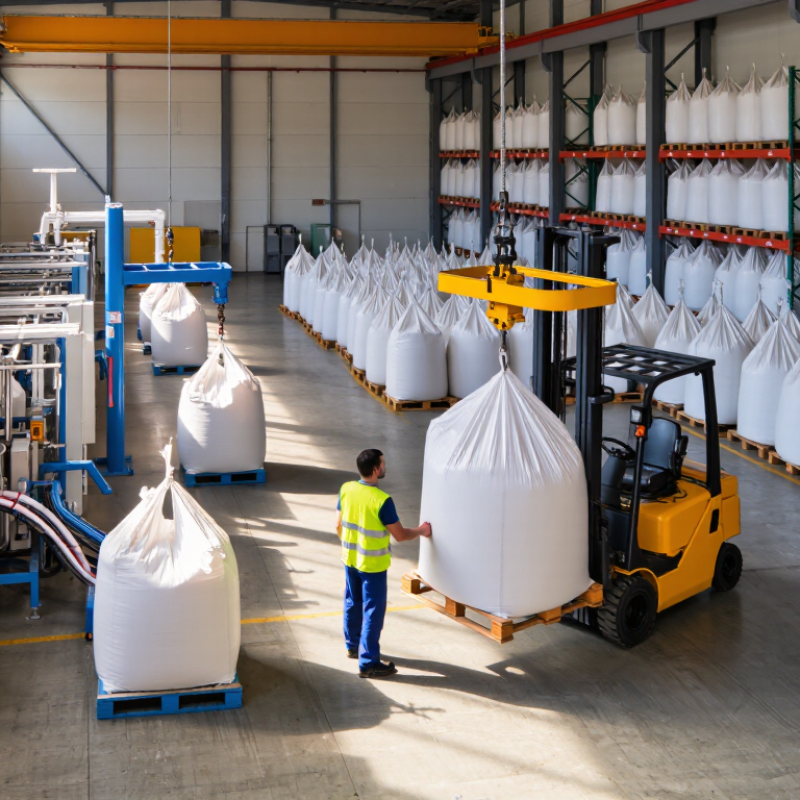
Identify the Contents: FIBCs Under ISO 21898 Are for Non-Dangerous Goods
When comparing stock bulk bags, identify the contents before choosing a fabric, capacity, or discharge style. ISO 21898 covers flexible intermediate bulk containers intended for non-dangerous goods. It sets design and performance requirements, but it does not confirm that every compliant bag suits every product. A bag carrying dry grain may not behave like one filled with fine mineral powder.
Check the product’s weight, particle size, flow, and moisture exposure. These details affect filling, lifting, and emptying. Consider whether the contents need an inner liner, and confirm that the bag’s safe working load fits the actual filled weight. Small details matter. A narrow outlet, for example, can slow discharge when fine material compacts. Real handling is rarely perfect.
Ask for product specifications and relevant test documentation, then compare them with your intended use. Inspect stored bags for torn seams, damaged lifting loops, or signs of moisture before filling. Keep contents clearly identified, especially when several materials share a storage area. The ISO reference is a useful starting point, not a substitute for checking compatibility. It is easy to overlook that distinction.
Match Bag Capacity to Load: Common Safe Working Loads Range from 500 to 2,000 kg
A stock bulk bag’s safe working load (SWL) should match the heaviest load it will actually carry, not just the usual one. Common ratings range from 500 to 2,000 kg, but a higher number is not automatically the better choice. Check the bag’s printed rating and documentation before filling it. A 1,000 kg bag of dense mineral material can reach its limit quickly, even when it looks only partly full. Volume can mislead.
Allow for the product’s density, moisture, and how evenly it settles. Then consider how the bag will be lifted and stored. Forklift tines should support the loops correctly, and the filled bag should sit on a stable surface. Small details matter. A load that shifts during filling may strain one side more than expected. It is tempting to choose extra capacity “just in case,” but a much larger bag can be awkward to handle and may encourage overfilling. Match the rated capacity to the real load, and leave room for normal variation. If the product or filling process changes, reassess the bag choice; the original estimate may no longer fit.
| Tip | What to Check | Practical Guidance | Example or Data |
|---|---|---|---|
| 1. Determine the heaviest load | Calculate the maximum net product weight per bag, not just the typical weight. | Include normal variation in fill weight and use a suitable weighing process. | If the maximum planned load is 900 kg, select a bag rated for at least 900 kg SWL. |
| 2. Match the bag's SWL to the load | Check the Safe Working Load (SWL) marked on the bag or its specification. | Never exceed the stated SWL. Common stock-bag ratings include 500, 1,000, 1,500, and 2,000 kg. | A 1,000 kg maximum load requires an SWL of 1,000 kg or higher. |
| 3. Account for product density | Estimate the product's bulk density, which varies with moisture, particle size, and settling. | Approximate volume required in cubic metres = load in kilograms ÷ bulk density in kg/m³. | For 1,000 kg at 800 kg/m³, the estimated product volume is 1.25 m³. |
| 4. Check usable bag volume | Compare the calculated product volume with the bag's stated capacity and filling requirements. | Do not assume that a bag's volume alone indicates its load rating; both volume and SWL must be suitable. | A 1 m³ bag may be too small for 1,000 kg of a low-density product. |
| 5. Confirm bag dimensions and fit | Check the bag's filled footprint and height against pallets, racking, doors, and storage space. | Filled dimensions depend on the bag design and the product; confirm dimensions with a sample or specification. | Allow room for safe access to lifting loops and for the filled bag's shape to vary. |
| 6. Match the bag to the lifting method | Verify that the loops, lifting equipment, and handling procedure are compatible. | Lift using all designated loops as instructed; keep people clear of suspended loads and avoid sharp or damaged forks. | The rated SWL applies only when the bag is used and handled as specified. |
| 7. Check use, condition, and documentation | Confirm whether the bag is intended for single-trip or multiple-trip use, and inspect it before filling. | Follow the supplier's instructions and applicable workplace rules. Do not use bags with damaged seams, loops, or fabric. | Verify the bag's SWL and intended use from its label or accompanying documentation. |
SWL is the maximum working load specified for the bag. Product volume estimates are indicative; confirm actual density, bag specifications, and safe handling requirements before use.
Check Safety Factor: ISO 21898 Uses 5:1 for Single-Trip FIBCs
7 Tips for Choosing Stock Bulk Bags
Check Safety Factor: ISO 21898 Uses 5:1 for Single-Trip FIBCs
For a single-trip FIBC, ISO 21898 commonly applies a 5:1 safety factor. This compares the bag’s tested breaking load with its rated safe working load (SWL). A bag rated for 1,000 kg should not be treated as safe for a 5,000 kg load. The ratio is a design and test criterion, not permission to overload. Check the SWL printed on the bag and match it to the material, filling method, and handling equipment.
Tip: Verify the safety factor, SWL, and intended use on the product documentation. Confirm that test information applies to the same bag design, including its lifting loops and seams. Check dimensions, liner needs, and discharge style, too. Small mismatches can cause trouble at the filling station.
A safety factor alone cannot prevent damage. Sharp pallet edges, uneven lifting, damp storage, or repeated use may weaken a bag. Single-trip bags are not automatically suitable for reuse, even if they look intact. Inspect seams, loops, and fabric before filling; reject bags with cuts or fraying. It’s easy to focus on the printed rating and overlook handling conditions. I would double-check those details before ordering a full stock.
Select Fill and Discharge Features for the Material and Handling Process
A stock bulk bag should suit the material and the equipment that fills it. Match the fill opening to the chute, product flow, and dust-control setup. For fine powders, a closable spout and dust sleeve can help contain clouds during filling. Coarse granules may load more easily through a wider opening. Measure it first. Product density and moisture can change how a bag settles, so a familiar material may still behave differently after storage.
Discharge needs equal care. Check that the bottom spout fits the hopper and can be opened without awkward reaching. Free-flowing pellets may empty through a standard spout, while cohesive powders can bridge and leave residue. A liner or different outlet geometry may help, but test it with the actual material. Dust travels. The U.S. Bureau of Labor Statistics reported 2.6 million nonfatal workplace injury and illness cases in private industry in its 2023 Survey of Occupational Injuries and Illnesses. That figure is not bag-specific, but it reinforces the value of controlled handling and clear access around the discharge point.
Before ordering stock, run a trial fill and empty cycle. Watch for leakage at seams, trapped material, unstable settling, and spillage around the hopper. Confirm the bag’s rated capacity and handling configuration against the load and lifting method. A specification sheet can look complete and still miss a real-world snag: sometimes the outlet clears the frame, but not the operator’s hands. Tweak the setup.
Verify Testing and Reuse Ratings: Multi-Trip FIBCs Use a 6:1 Safety Factor
When choosing stock bulk bags, ask for the test record and the stated safe working load (SWL). For a multi-trip FIBC, a 6:1 safety factor means its tested breaking load is six times its rated load. It does not mean the bag can carry six times the SWL. Check that the rating applies to the exact bag design, including its fabric, seams, lifting loops, and discharge features. A generic certificate may not tell you enough.
Look for clear identification, test dates, and instructions on permitted reuse. Then inspect each bag before filling: check for torn fabric, damaged stitching, worn loops, or a distorted base. Small defects matter. Dust can hide them. Reuse ratings also assume controlled handling and storage; sunlight, moisture, abrasion, and rough forklift contact can shorten service life. A bag that looks clean may still have weakened lifting points. That is easy to overlook. Keep inspection notes and remove any bag with uncertain damage from service. The 6:1 ratio is a design and testing criterion, not a substitute for the SWL, operating instructions, or a careful inspection.
Verify Testing and Reuse Ratings: FIBC Safety Factors
Common FIBC design safety factors are 5:1 for single-trip bags and 6:1 for multi-trip bags. The ratio compares the bag’s tested breaking load with its safe working load; it does not by itself certify a bag for reuse. Check the bag’s test documentation, reuse instructions, and condition before each use.
